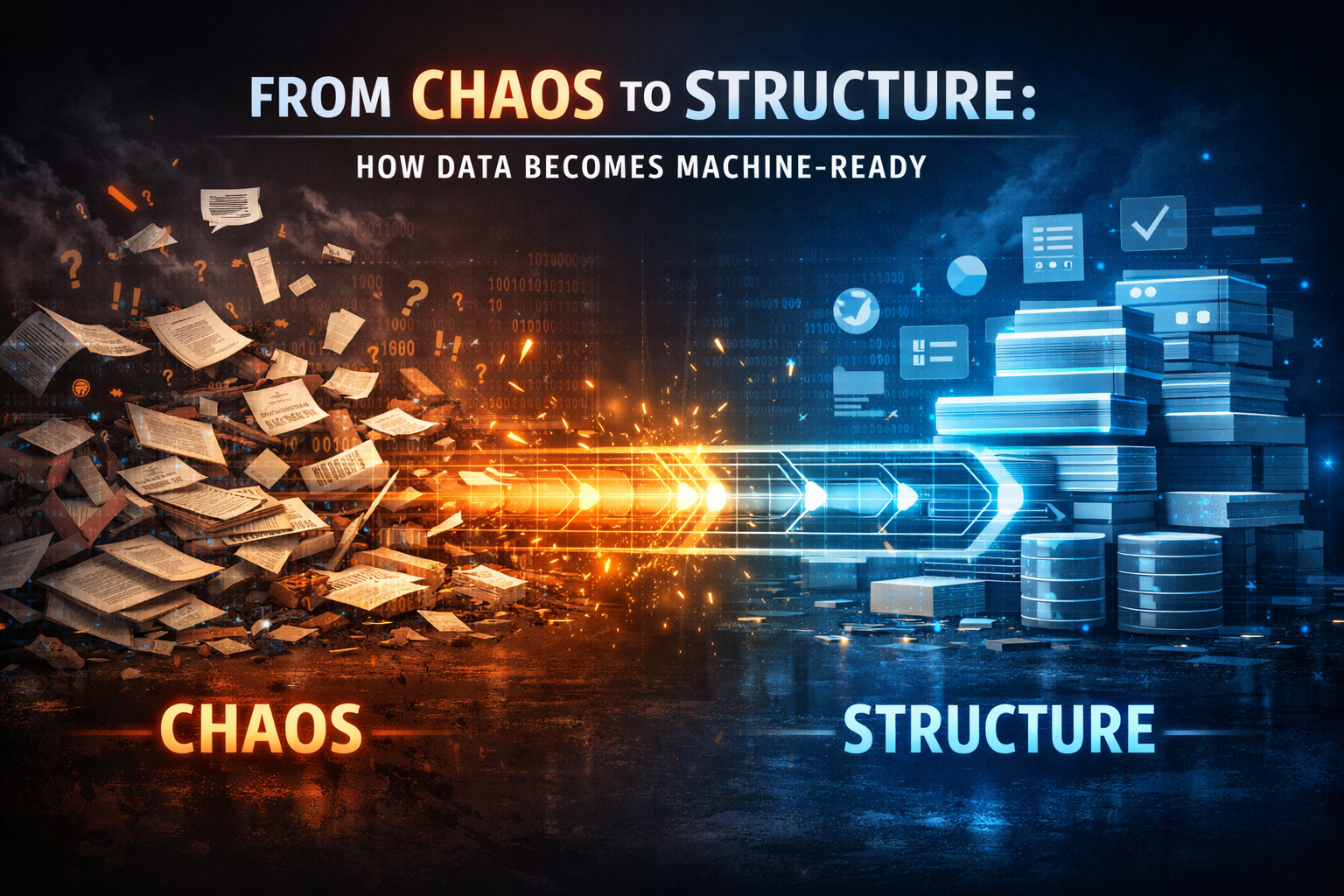
Most people think AI is powerful because of the model. It’s not. It’s power comes from the data.
And more importantly, because of what happens to that data before it ever touches a model. Because raw data? Is chaos.
The Illusion of “Ready” Data
Contrary to popular belief, a PDF is not data. A scanned journal is not data. A collection of articles, even from highly respected sources, is not data.
It’s content. Unstructured. Inconsistent and messy. And if you feed that directly into a model? You don’t get intelligence. You get noise.
What Chaos Actually Looks Like
Before data becomes usable, it looks like:
- Broken formatting
- OCR errors (misread characters, missing text, duplicated lines)
- Inconsistent structures across documents
- Embedded artifacts (headers, footers, page numbers, citations)
- Irrelevant or redundant sections
- Encoding inconsistencies
It’s not just messy, it’s unreliable. And unreliable data doesn’t just slow down AI. It quietly corrupts it.
The Transformation Layer (Where the Real Work Happens)
This is the part no one talks about. Because it’s not flashy. It doesn’t demo well.
And it takes time.
But this is where value is created. Turning chaos into machine-ready data requires:
1. Extraction
Pulling content out of its original format (PDFs, scans, archives) into raw text.
2. Cleaning
Removing noise:
- Headers/footers
- Page numbers
- Broken line breaks
- OCR artifacts
3. Normalization
Standardizing:
- Structure
- Formatting
- Encoding
- Section consistency
4. Segmentation
Breaking content into logical units:
- Articles
- Sections
- Paragraph-level chunks
This is critical for retrieval and model performance.
5. Metadata & Tagging
Adding context:
- Title
- Author
- Publication
- Date
- Category
Without metadata, data is just… floating text.
6. Validation
Checking for:
- Completeness
- Accuracy
- Consistency
Because one bad dataset can poison an entire pipeline.
Machine-Ready Doesn’t Mean “Perfect”. It Means “Reliable”
This is where people get it wrong. You’re not trying to create perfection. You’re creating trustworthiness.
Machine-ready data means:
- The structure is consistent
- The noise is minimized
- The meaning is preserved
- The system can depend on it
That’s it.
But that “that’s it”… is everything.
Why This Matters More Than the Model
You can have the most advanced model in the world.
But if you train it on:
- Reddit scraps
- Poor OCR outputs
- Unverified content
- Inconsistent formatting
You’re building intelligence on top of instability, and it will show. In hallucinations, in contradictions, and in subtle, dangerous inaccuracies.
This Is Where the Real Value Is
Not in prompting, not in front-end interfaces, not even in the model itself. The real value is in curated, structured, high integrity data pipelines.
Because whoever controls clean, reliable data, controls the outcome.
Final Thought
We don’t train human doctors on disorganized, error-filled notes pulled from random sources. We train them on structured, vetted, high-quality information.
AI should be no different. And until we start treating data with that level of care, we’ll keep blaming the model for problems that were never its fault.